

When you think of Ashton Kutcher, you probably picture Michael Kelso from “That ’70s Show” or that guy who pranked celebrities on MTV. What you might not picture is a sharp eyed tech investor sitting on stakes in some of the biggest startups of the last two decades. But that’s exactly who Kutcher has become.
So, what is Ashton Kutcher’s net worth in 2026? Most reputable sources place it at around $200 million, with some estimates pushing the range up to $250 million depending on how you value his private investments. According to Celebrity Net Worth, Ashton Kutcher has an astounding net worth of $200 million in 2026. That’s a serious number for someone who started out as a farm kid in Iowa with no industry connections.
In this article, we’ll break down where that wealth comes from, how his career evolved, and why his investment portfolio might actually be the most interesting part of his story.
Profile Summary
| Detail | Information |
| Full Name | Christopher Ashton Kutcher |
| Date of Birth | February 7, 1978 |
| Birthplace | Cedar Rapids, Iowa, USA |
| Profession | Actor, Producer, Entrepreneur, Venture Capitalist, Philanthropist |
| Famous For | “That ’70s Show” (Michael Kelso), “Two and a Half Men” |
| Net Worth (2026) | ~$200 million (range up to $250 million) |
| Investment Firms | A-Grade Investments, Sound Ventures |
| Notable Investments | Uber, Airbnb, Spotify, Skype, Shazam, SoundCloud, OpenAI |
| Spouse | Mila Kunis |
| Philanthropy | Co-founder of Thorn (anti human trafficking organization) |
Quick Overview: Ashton Kutcher’s Net Worth at a Glance
Before we dive deep, here’s the short version for anyone in a hurry.
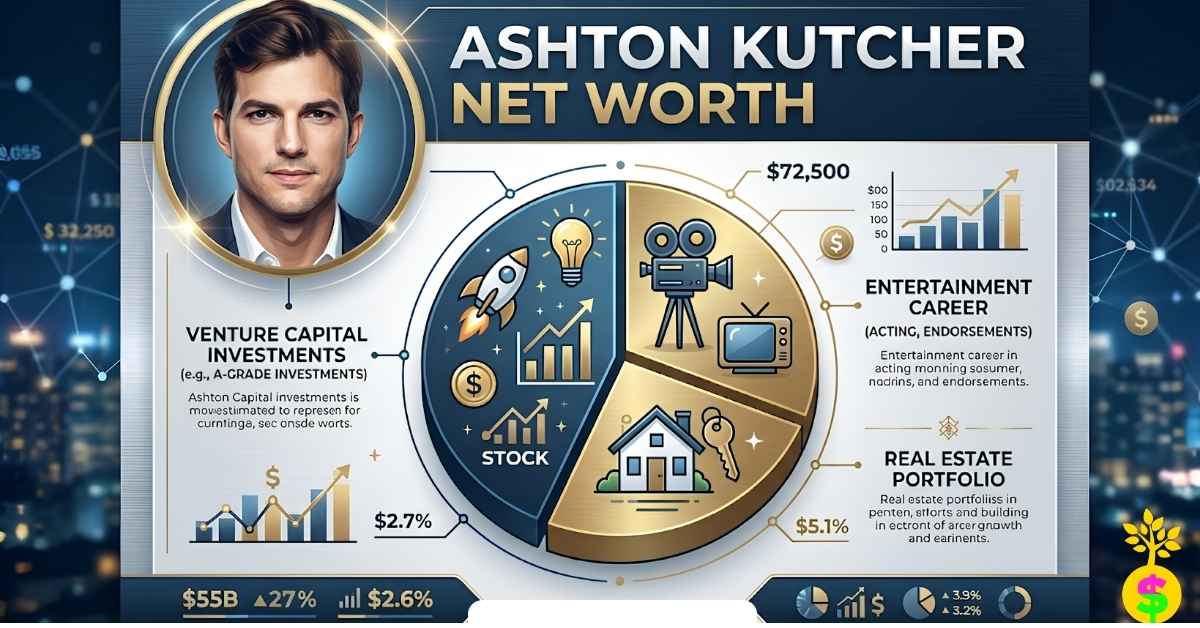
Ashton Kutcher’s estimated net worth sits at approximately $200 million as of 2026. His wealth comes from three main pillars: acting income, television production, and venture capital investments. While his acting career built the foundation, his tech investments have arguably done the heavy lifting in recent years.
It’s worth noting that net worth figures for celebrities are estimates, not audited financial statements. Private investment values, in particular, are notoriously hard to pin down because they depend on company valuations that change constantly. So treat any number you see, including the ones in this article, as an informed approximation rather than gospel.
From Iowa to Hollywood: The Early Years
Ashton Kutcher was born in 1978 in Iowa, a state better known for cornfields than movie stars. He didn’t grow up dreaming of red carpets. In fact, his original plan involved biochemical engineering, not acting.
A modeling scout discovered him while he was attending the University of Iowa, and that chance encounter changed the trajectory of his life completely. He moved to Los Angeles, started modeling, and within a short time landed the role that would define his early career: Michael Kelso on “That ’70s Show.”
The sitcom ran from 1998 to 2006 and turned Kutcher into a household name almost overnight. It also gave him something far more valuable than fame: a foothold in an industry where connections matter more than almost anything else.
The “Two and a Half Men” Paycheck Era
After “That ’70s Show” wrapped, Kutcher kept his momentum going with film roles and television work. But the real financial turning point came when he stepped into a major primetime sitcom role following a high profile cast shakeup.
When Charlie Sheen was famously let go from “Two and a Half Men,” Kutcher stepped in as his replacement. This single career move significantly boosted his earnings. During this period, he became the highest paid actor on TV, earning an estimated $24 million between June 2012 and June 2013 alone.
Per episode figures from this era are commonly cited in the range of $700,000 to $800,000, depending on the source and the season in question. Either way, the math is simple: a sitcom that ran for many episodes per season, multiplied by a six figure per episode rate, adds up fast.
This period is widely considered the moment Kutcher’s bank account stopped looking like a typical actor’s and started looking like something closer to a small business empire.
The Pivot Nobody Saw Coming: Venture Capital
Here’s where Kutcher’s story stops being a typical “actor gets rich” tale and starts being genuinely interesting from a business perspective.
Around 2010, while still acting full time, Kutcher co-founded a venture capital firm called A-Grade Investments alongside music industry executive Guy Oseary. Most actors dabble in restaurants or fashion lines. Kutcher decided to dabble in software startups, which, in hindsight, was a slightly better idea.
A-Grade Investments made early bets on companies that were small at the time but went on to become household names. Some of the most notable early investments include Uber, Airbnb, Spotify, Skype, and Shazam.
Think about that for a second. These weren’t safe, boring bets. They were early stage startups with no guarantee of success. Investing early in companies like Uber and Airbnb back then was a bit like buying lottery tickets that actually had decent odds, if you knew what you were looking for.
Sound Ventures and the Bet on Artificial Intelligence
After A-Grade Investments, Kutcher and Oseary launched a second firm called Sound Ventures. This is where things get even more relevant to today’s tech landscape.
In 2023, Sound Ventures made a move that looks almost prophetic now: it invested in OpenAI during one of the company’s earlier large funding rounds. At the time, OpenAI was valued in the range of roughly $20 billion to $30 billion, and Sound Ventures reportedly deployed around $30 million into the company.
Fast forward to 2026, and the AI boom has been nothing short of explosive. In March 2026, OpenAI raised $122 billion at an $852 billion valuation, instantly becoming one of the most valuable private companies in the world. That’s not a typo. Eight hundred and fifty two billion dollars.
So what does that mean for Kutcher’s stake? A leaked cap table revealed that Sound Ventures owns approximately 0.15% of OpenAI, a stake now worth roughly $1.3 billion on paper.
Let that sink in for a moment. A $30 million bet, made a few years earlier, is now theoretically worth over a billion dollars on paper. Of course, “on paper” is the key phrase here. Private company valuations are not the same as cash in the bank, and paper gains can shrink just as fast as they grow. Still, it’s an extraordinary illustration of how early stage investing can pay off when you pick the right horse.
This is also why you’ll see some sources estimate Kutcher’s overall net worth significantly higher than $200 million when factoring in this stake, while more conservative estimates stick closer to the $200 million to $250 million range that accounts for liquidity risk and market volatility.
Why Net Worth Estimates Vary So Much
If you’ve searched for celebrity net worth figures before, you’ve probably noticed that different websites report different numbers for the same person. This isn’t necessarily because someone is wrong. It’s because net worth is genuinely difficult to calculate for people whose wealth includes private investments.
Here’s a simple breakdown of why the numbers move around:
Public company stocks have a clear daily price, so those are easy to value. Private startup equity, on the other hand, is only “worth” what someone is willing to pay for it, and that number changes every time a new funding round happens.
Real estate holdings also fluctuate with the housing market, and most celebrities don’t publicly disclose their full property portfolios.
Acting income is often reported in ranges because contract details aren’t always made public, and per episode rates can change between seasons.
So when one source says $200 million and another says $250 million, both could be reasonable estimates based on slightly different assumptions about how to value Kutcher’s private equity stakes.
Breaking Down Ashton Kutcher’s Income Sources
Let’s organize this into something cleaner. Kutcher’s wealth generally comes from four categories.
Acting and Television Work
This is the foundation. From “That ’70s Show” to “Two and a Half Men” to various film roles, Kutcher’s acting career generated significant income over more than two decades. While acting alone wouldn’t likely have built a $200 million fortune, it provided the capital that allowed him to start investing seriously.
Production and Behind the Camera Work
Kutcher has also worked as a producer on various television projects. Production credits often come with additional fees and, in some cases, ongoing royalties or back-end deals tied to a show’s success.
Venture Capital Investments
This is the big one. Through A-Grade Investments and later Sound Ventures, Kutcher built a portfolio that includes stakes in companies like Uber, Airbnb, Spotify, Skype, Shazam, SoundCloud, and more recently, OpenAI. Some of these investments have generated returns that dwarf his acting income entirely.
Endorsements and Real Estate
Like most celebrities of his level, Kutcher has participated in endorsement deals over the years. He and his wife, Mila Kunis, also hold real estate assets, which contribute to overall net worth even if they’re harder to quantify precisely from public information.
The Mila Kunis Factor
Speaking of Mila Kunis, it’s worth noting that Kutcher’s personal life and finances are somewhat intertwined with hers. The two met as teenagers on the set of “That ’70s Show,” reconnected years later, and eventually married in 2015.
Kunis has her own successful acting career and her own business ventures, which means the household’s combined financial picture is likely larger than Kutcher’s individual net worth alone. However, most net worth estimates focus on individuals separately, so the $200 million figure typically refers to Kutcher specifically, not the couple’s joint assets.
Philanthropy: Where Some of That Money Goes
Not all of Kutcher’s financial story is about accumulation. He’s also been notably involved in philanthropic work, most prominently as a co-founder of Thorn, an organization focused on combating child sexual exploitation and human trafficking through technology.
This matters for a couple of reasons. First, it shows that Kutcher’s tech savviness extends beyond chasing investment returns into using technology for social good. Second, charitable commitments and donations are part of how wealthy individuals manage their overall financial picture, even if they don’t directly reduce a headline net worth figure in any dramatic way.
How Does Kutcher’s Wealth Compare to Other Actors?
It’s tempting to assume every famous actor from a hit ’90s or early 2000s sitcom ended up a multimillionaire many times over. The reality is more nuanced. Plenty of actors from that era earned solid incomes during their peak years but didn’t necessarily turn that income into long term wealth through investing.
What sets Kutcher apart isn’t that he made a lot of money acting, plenty of his peers did too. It’s what he did with that money afterward. Most working actors don’t co-found venture capital firms. Most don’t end up with early equity in companies that later become global brands.
This is why Kutcher often gets mentioned in business and finance circles, not just entertainment news. His career bridges entertainment, entrepreneurship, and technology, showing how diversified income streams can build lasting financial security, which is a useful lesson well beyond the world of celebrity gossip.
Is Ashton Kutcher a Billionaire?
Short answer: no, not based on current public information. While the OpenAI stake has generated headlines suggesting his paper wealth could be significantly higher than previously thought, most verified estimates still place his overall net worth in the $200 million to $250 million range.
Becoming a billionaire requires sustained, massive asset growth across multiple holdings, not just one impressive investment. Even a billion dollar paper stake in a single company doesn’t automatically translate to billionaire status once you factor in taxes, illiquidity, and the fact that private valuations can swing significantly before any actual sale occurs.
So while “Kutcher could be a billionaire on paper because of OpenAI” makes for a catchy headline, the more grounded reality is that he remains a very wealthy, but not ultra wealthy, individual by current standards.
Lessons from Kutcher’s Financial Journey
You don’t need to be a Hollywood actor to take something useful from this story. A few patterns stand out.
Diversification matters. Relying on a single income stream, even a lucrative one like acting, leaves you exposed if that industry shifts. Kutcher didn’t wait for his acting career to slow down before building other income sources.
Timing and access both play a role. Kutcher had access to Silicon Valley networks that most people don’t have, and he used that access early, before companies like Uber and Airbnb were household names. Early access combined with willingness to take risks is a powerful combination.
Paper gains aren’t the same as cash. The OpenAI stake is a great example of impressive numbers that look fantastic in headlines but remain theoretical until there’s an actual exit or sale.
Frequently Asked Questions
What is Ashton Kutcher’s net worth in 2026?
Most estimates place it at approximately $200 million, with some sources suggesting a range up to $250 million when factoring in private investment valuations.
How did Ashton Kutcher make his money?
Primarily through acting income from shows like “That ’70s Show” and “Two and a Half Men,” combined with venture capital investments through A Grade Investments and Sound Ventures.
What companies has Kutcher invested in?
His portfolio includes early investments in Uber, Airbnb, Spotify, Skype, Shazam, SoundCloud, and more recently, OpenAI.
Is Ashton Kutcher a billionaire?
Based on current public estimates, no. His net worth is generally placed well below billionaire status, even accounting for high value private stakes.
Why do net worth estimates for Kutcher vary?
Because private equity stakes, like his investment in OpenAI, don’t have a fixed daily market price the way public stocks do. Different sources make different assumptions about how to value these holdings.
Final Thoughts
Ashton Kutcher’s financial story is a reminder that careers don’t have to follow a straight line. He went from studying biochemical engineering to playing a goofy sitcom character to sitting on a multi billion dollar OpenAI cap table. If you’d told someone in 1998 that the guy playing Kelso would one day be discussed alongside Silicon Valley venture capitalists, they probably would’ve laughed.
But that’s exactly what happened. Ashton Kutcher’s net worth of roughly $200 million reflects decades of acting success, smart timing, and a willingness to bet on technology before it became mainstream. Whether or not his OpenAI stake ever translates into a massive cash payout, his journey from Iowa farm boy to tech investor remains one of the more unexpected success stories in modern entertainment and business.
