

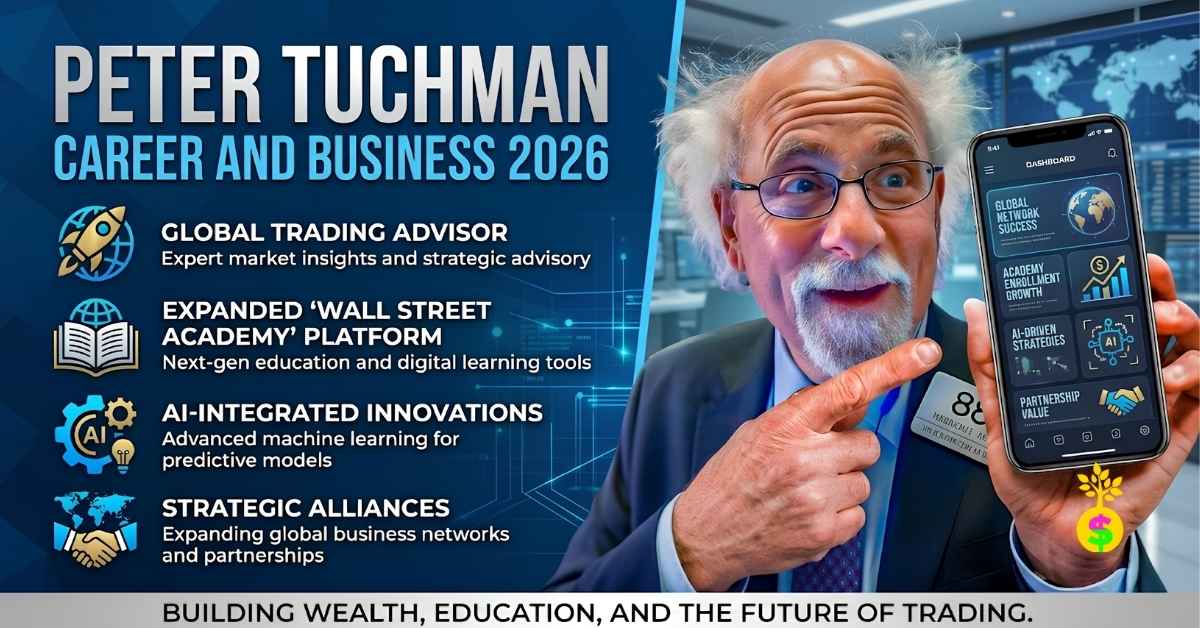
Peter Tuchman’s career and business story is unlike almost anything else on Wall Street. Most people recognize his face from news photographs taken during market crashes. Far fewer understand the full professional engine behind that face.
Over four decades, Tuchman quietly built a layered business presence that stretches well beyond the trading floor. He runs a trading academy, co-hosts a finance podcast, commands massive media attention, and handles between $500 million and $1 billion in trades daily for institutional clients.
This article is not about his biography or net worth. It is about how he actually built his career, what business ventures he runs today, and what working professionals and entrepreneurs can genuinely learn from his approach.
How Peter Tuchman Actually Started: The Career Foundation
Tuchman did not walk onto Wall Street with a finance pedigree and a fast track into trading. His path was more interesting and, honestly, more instructive than that.
He graduated from the University of Massachusetts Amherst with a degree in economics and agriculture. He also briefly pursued a master’s degree in landscape architecture before dropping out and returning to New York City. Before finance, he ran a record store. He also worked for a Norwegian oil company in Africa. These were not detours. They were formative experiences that built adaptability into his character long before he needed it on the trading floor.
On May 23, 1985, he started as a teletypist at Cowen and Co. on the NYSE floor. The role involved entering trade orders as they came in, giving him a ground-level view of how the floor actually operated. He learned the mechanics of the exchange from the bottom up, which later gave him a structural understanding that many traders who entered at higher levels never developed.
By 1988, he had advanced to a full broker role. From that point, his career was underway in earnest.
Peter Tuchman Career Timeline
1985 : Joins the NYSE floor as a teletypist at Cowen and Co. on May 23rd.
1987 : Works through Black Monday, one of the largest single-day percentage drops in Dow Jones history. As a clerk at the time, he absorbs the chaos firsthand.
1988 : Advances to the role of full floor broker. His professional career as a trader officially begins.
2000 to 2002 : Navigates the dot-com crash while continuing to execute institutional trades.
2008 : Works through the financial crisis. His expressive reactions on the trading floor begin attracting regular media attention during high-volatility sessions.
2011 : Joins Quattro M Securities Inc., a firm focused on institutional equity trading. The move positions him with a well-regarded professional firm that expands his client base.
2020 : Contracts COVID-19 in March and faces a serious health battle. Recovers and returns to the trading floor.
2022 and beyond : Transitions to TradeMas Inc., his current professional home, where he continues high-volume institutional floor trading.
Ongoing : Runs the Wall Street Global Trading Academy, co-hosts The Money Signal podcast, and maintains over 1 million followers across social media platforms.
Business Ventures: What Peter Tuchman Actually Runs
This is the section most people miss. Tuchman has built real business structures alongside his trading career. None of these are passive brand partnerships. They involve active work and reflect a deliberate strategy to diversify his professional output.
Wall Street Global Trading Academy
Tuchman co-founded the Wall Street Global Trading Academy alongside educator David Green. The academy is an online platform that teaches aspiring traders the fundamentals of stock market mechanics, risk management, and floor broker strategy.
The program features live sessions every Tuesday and Thursday at 6 PM EST, where participants watch trade techniques develop in real time during active futures markets. Additionally, the academy runs a weekly mentorship including a live Q and A every Thursday night with Tuchman and Green. All sessions are recorded and archived for members who cannot attend live.
This is a genuine educational business, not simply a branded course collection. It targets both beginners and more experienced traders who want to understand how a professional floor broker actually approaches the market.
The Money Signal Podcast
Tuchman co-hosts The Money Signal: From Main Street to Wall Street, a finance and markets podcast produced by GLORION MEDIA. His co-host is Tsvetta Kaleynska, a consumer intelligence entrepreneur. The program focuses on market psychology, consumer sentiment, and trading insights viewed through the lens of NYSE floor experience.
This venture gives Tuchman a long-form media presence that his television appearances cannot provide. It reaches audiences who want deeper analysis rather than a quick reaction shot during a volatile market session.
Trade Like Einstein Podcast
Tuchman also launched the Trade Like Einstein podcast on the Money News Network. This platform delivers regular market analysis directly from his perspective on the NYSE floor. It extends his reach into a growing audience of retail investors who consume finance content in podcast format rather than through traditional television channels.
Media Commentary and Appearances
CNBC, Fox Business, the Wall Street Journal, and CNN regularly feature Tuchman during significant market events. These are not paid advertising arrangements. They are editorial appearances driven by his reputation and visual recognizability. However, the indirect business value is considerable. Each major media appearance reinforces his profile, which in turn attracts higher-value institutional clients to his brokerage work.
As one of the most cited sources confirms, greater media visibility attracts better clients, which leads to larger trades and higher commission earnings overall. Tuchman has understood this compounding effect intuitively throughout his career.
How Peter Tuchman Built Multiple Income Streams
Most floor traders operate from a single income source: brokerage commissions. Tuchman built several distinct streams that reinforce one another. Here is how that system actually works.
Floor brokerage commissions form the foundation. As a senior floor trader at TradeMas Inc., he earns a percentage on every institutional trade he executes. At reported volumes of $500 million to $1 billion daily, the commission income from consistent, high-volume execution across four decades is substantial.
Media appearance fees and brand value come next. Television and podcast appearances do not pay comparably to trading commissions. However, they expand his client reach, attract institutional relationships, and sustain the public profile that keeps him relevant well beyond his trading years.
Trading academy revenue adds a third layer. The Wall Street Global Trading Academy generates direct income through course fees and mentorship memberships. It also adds a legacy income dimension that continues generating revenue independently of daily market activity.
Speaking engagements round out the picture. Tuchman speaks at financial conferences including MoneyShow, where he has appeared in Las Vegas to discuss technology stocks and the AI revolution. He also participates in investor education events for programs like Athletes Invest. These engagements generate both fees and further visibility.
Together, these streams form a self-reinforcing system. Each one feeds the others.
Peter Tuchman Business Strategy: What He Does Differently
Tuchman’s business approach is not flashy. However, it is remarkably consistent and surprisingly sophisticated for someone who presents himself primarily as a floor trader rather than an entrepreneur.
He turned visibility into leverage. Most traders are invisible. Tuchman became the opposite by simply being himself in front of cameras during major market events. Over time, that authenticity built a brand that now functions as a business asset in its own right. He did not hire a publicist to achieve this. Tuchman showed up authentically and let the market tell its own story through his face.
He embraced education early. Rather than hoarding his knowledge, Tuchman packaged it into a teachable format through the Wall Street Global Trading Academy. This reflects an understanding that expertise has compounding value when shared systematically, not just applied personally.
He adapted to digital media without abandoning his core identity. Tuchman launched a TikTok presence and podcast strategy aimed at younger retail investors while maintaining his institutional trading career. Furthermore, he used his existing brand identity, the “Einstein of Wall Street” persona, to bridge both audiences instead of creating separate identities for each.
He stayed in the room. Perhaps the most underappreciated part of his business strategy is simply staying on the NYSE floor for over 40 years. In an era when electronic trading decimated traditional floor broker roles, Tuchman adapted his service offering and remained relevant. Longevity on the floor is itself a competitive advantage because it builds institutional relationships that newer players cannot replicate quickly.
Business Lessons Entrepreneurs Can Take from Peter Tuchman
Tuchman’s career offers several ideas that apply well beyond finance. These are not generic motivational observations. They are specific patterns visible in how he actually operates.
Personal brand built on authenticity outlasts personal brand built on positioning. Tuchman never engineered his public image. His expressions were genuine. Tuchman’s white hair is natural. His nickname emerged organically. The result is a brand that feels real because it is real. That kind of trust is extremely difficult to manufacture and equally difficult to destroy.
Expertise should be monetized in multiple formats. Tuchman’s knowledge earns money through commissions, through education, through media, and through speaking. Each format reaches a different audience. This approach maximizes the value of a single expertise base without requiring additional core skills to be developed.
Staying power creates opportunities that speed cannot. Many ambitious professionals sprint toward visible success early. Tuchman’s story suggests that showing up consistently in the same place for long enough creates compound advantages that no amount of early acceleration can replicate. Forty years of institutional relationships, earned reputation, and floor knowledge are genuinely irreplaceable.
Adapt the channel, not the message. Tuchman’s core message, long-term investing over short-term spending, has not changed significantly across his career. What changed is the medium through which he delivers it. From floor trading to television to TikTok to podcasts, the vehicle shifts. The philosophy stays constant.
Social Media as a Business Tool
Tuchman’s @einsteinofwallst handle has grown to over 1 million followers across social platforms. This is not incidental. It represents a deliberate extension of his business presence into channels where retail investors spend their attention.
His social content focuses on market commentary, investment education, and the principle he is most closely associated with: “Buy stocks, not stuff.” This philosophy encourages long-term equity ownership over consumer spending on depreciating goods. It is simple, memorable, and repeatable, which makes it ideal for social media formats.
Moreover, his son Benjamin now works alongside him on the NYSE floor, meaning the next generation of the Tuchman trading presence is already being established. This suggests that the business structures he has built may have continuity well beyond his own trading years.
Major Brands and Media Partners
Throughout his career, Tuchman has built relationships with the following major platforms and institutions.
CNBC and Fox Business have both used him repeatedly as a floor-level market commentator during volatile trading sessions. The Wall Street Journal and CNN have also featured him for editorial coverage. The Money News Network carries his Trade Like Einstein podcast. GLORION MEDIA produces The Money Signal alongside him. The NYSE itself has hosted events at his invitation, including visits from institutional partners and investment education programs.
These are not paid partnerships in the traditional advertising sense. They are professional relationships built on credibility and value that has been demonstrated consistently over decades.
Interesting Facts About Peter Tuchman’s Career and Business
- He started on the NYSE floor on May 23, 1985, as a teletypist at Cowen and Co., earning his place from the very first rung.
- His largest single recorded trade involved 10 million shares executed in one order.
- He has publicly stated that he has never personally owned individual stocks despite executing billions of dollars in trades for clients.
- He co-founded the Wall Street Global Trading Academy with educator David Green, running live market sessions twice weekly.
- His social media following surpassed 1 million across platforms, making him one of the most followed active floor traders anywhere.
- He appeared at MoneyShow Las Vegas in 2026 to discuss technology stocks and the AI revolution.
- His son Benjamin now works alongside him on the NYSE trading floor, extending the family’s floor trading presence into a second generation.
- He has been described as the longest-tenured active trader on the NYSE floor with over 41 years of continuous presence.
Frequently Asked Questions
What is Peter Tuchman’s primary business today?
His primary business remains floor brokerage at TradeMas Inc. on the NYSE. Beyond trading, he co-runs the Wall Street Global Trading Academy and co-hosts two finance podcasts.
What is the Wall Street Global Trading Academy?
It is a live trading education platform co-founded by Tuchman and educator David Green. It offers online courses, live market sessions twice weekly, and a weekly mentorship Q and A for aspiring traders.
Which firm does Peter Tuchman currently work for?
As of 2026, Tuchman works at TradeMas Inc. He previously worked at Quattro M Securities Inc. from 2011 to approximately 2022.
How much does Peter Tuchman trade daily?
Reported figures suggest his daily trading volume ranges between $500 million and $1 billion, with his largest single recorded trade involving 10 million shares.
Does Peter Tuchman personally invest in stocks?
According to his own public statements, he does not personally own individual stocks. He focuses entirely on executing trades for institutional clients.
What podcasts does Peter Tuchman host?
He co-hosts The Money Signal: From Main Street to Wall Street on GLORION MEDIA alongside Tsvetta Kaleynska, and he hosts the Trade Like Einstein podcast on the Money News Network.
How did Peter Tuchman build his personal brand?
His brand developed organically through decades of media coverage during market-moving events. His distinctive appearance and genuine emotional reactions made him the most photographed trader on the NYSE floor, which he later extended into social media under @einsteinofwallst.
What is Peter Tuchman’s most well-known business philosophy?
His most widely cited principle is “Buy stocks, not stuff,” which encourages long-term equity ownership over short-term consumer spending on goods that lose value over time.
Conclusion
Peter Tuchman’s career and business success did not come from a single breakthrough moment. It came from showing up on the same trading floor for over 40 years, building institutional trust one client relationship at a time, and then systematically extending that expertise into education, media, and digital content.
What makes his story genuinely instructive is the architecture behind it. Each income stream supports the others. The media builds the brand. The brand attracts clients. The clients generate commissions. The education platform cements his legacy. The podcasts reach the next generation. Together, these pieces form something considerably more durable than a trading career alone would produce.
For anyone building a career or business in a field that demands deep expertise, Tuchman’s approach offers a real and applicable model: go deep on one skill, stay consistent over time, teach what you know, and never stop showing up.
